
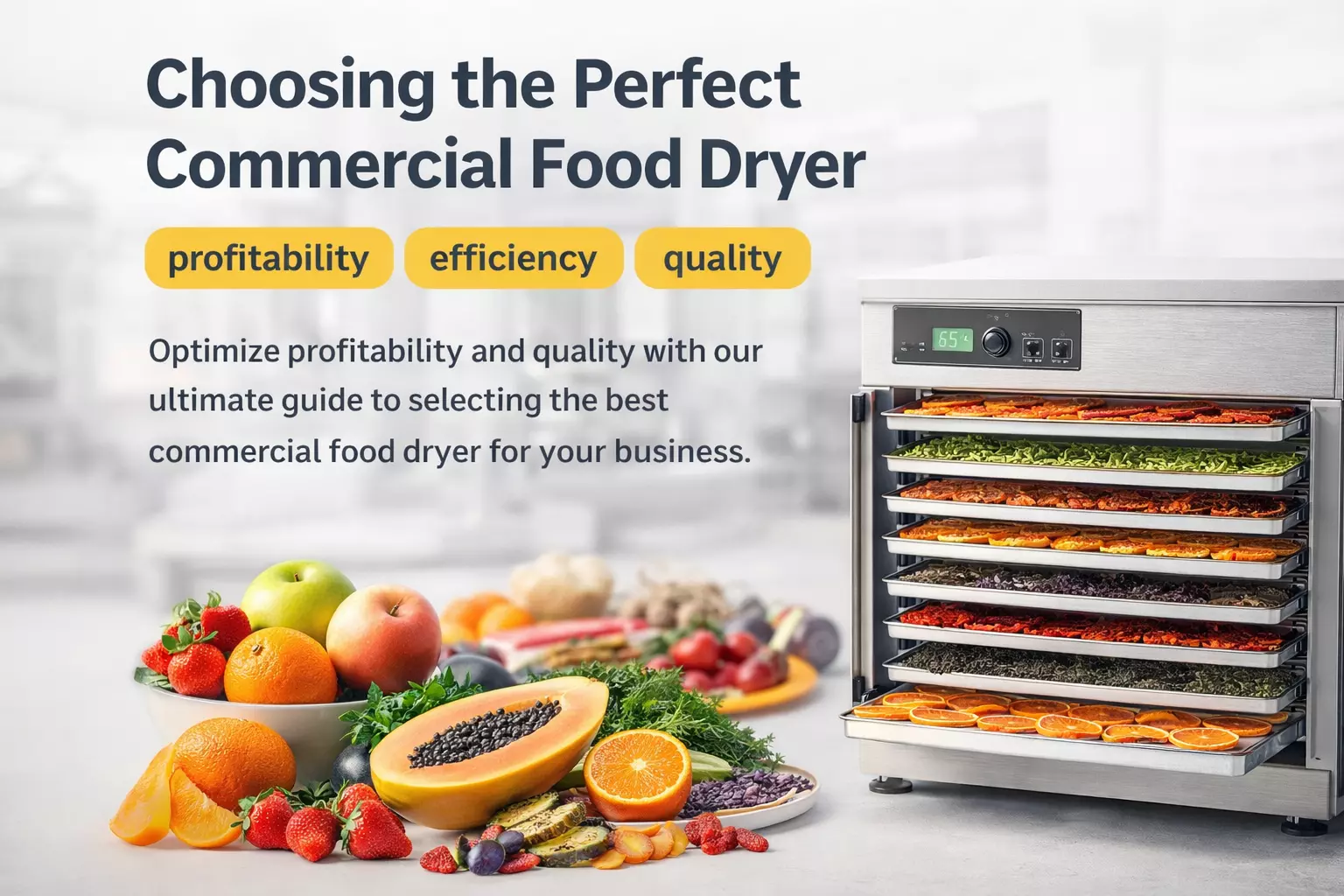
commercial food dryer remains one of the most searched terms among importers, central kitchens and food factories upgrading their processing lines. The right machine choice affects throughput, labor cost and export compliance.
1. Define your product and daily volume
Start with raw material type, target output (kg/h or pieces/h), and shift pattern. For commercial food dryer projects, buyers often compare standalone units vs integrated lines — especially when pairing with vegetable cutters, food dryers or poultry processing equipment.
- Batch vs continuous — match washing, cutting or drying cycles.
- Hygiene class — stainless contact surfaces, drainage, clean-in-place access.
- Power & utilities — confirm voltage, gas/steam and exhaust on site.
2. Compare total cost, not sticker price
Include installation, spare parts, energy and downtime. Related topics buyers also research: fruit drying, vegetable dehydrator, heat pump dryer, food drying ROI.
3. Request factory verification before PO
Ask for video trial with your material, reference projects in your region, and clear warranty terms. QSfoodmach supports OEM customization from Foshan with export documentation.
Tags: commercial food dryer, fruit drying, vegetable dehydrator, heat pump dryer, food drying ROI, commercial food machinery, food processing equipment, vegetable washer, vegetable cutter, meat cutting machine, food dryer, stir fry machine, poultry slaughtering equipment, chicken processing line, QSfoodmach